

When measuring team quality in the NBA, the most common metric used is net rating (NRtg), which is simply a team’s point differential per 100 possessions. While winning the most games is the goal, it has a couple of shortcomings when trying to determine a team’s quality. Firstly, a team doesn’t improve its win percentage as much as it improves its offensive and/or defensive efficiency. Wins are the result of thousands of possessions across a season. Teams can improve effectiveness on possessions, which will lead to wins. NRtg helps better express the granularity of the sport.
Secondly, NRtg better represents dominance. Two teams can win 50 games, but a team with a +4.5 net rating is better than a team with a +3.5 net rating, within the given sample.
However, comparing net ratings from different seasons is not an apples-to-apples comparison. Due to 3pt volume, the number of expansion and tanking teams, injuries and the depth and distribution of talent, the distribution of values have varied widely from season to season. Here is a graph showing the standard deviation of NRtg for every season since the ABA-NBA merger:
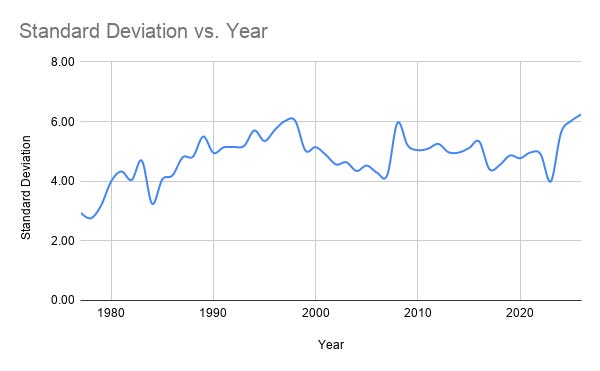
While the values have largely stayed between 4 and 6 since the 80s, those differences can have a meaningful difference in how we assess teams. To adjust the ratings, I simply divided a constant standard deviation (I used the average standard deviation, 4.83) by the standard deviation of each season. This gives us our adjustment multiplier. To show how this works, let’s take this year’s Oklahoma City Thunder. During the 2026 season, the standard deviation for net rating was 6.24, which gives us an adjustment multiplier of .77. Multiply that by the Thunder’s +11.2 net rating, and the NRtg becomes +8.67. This drops the 2026 Thunder down from the 8th-best value since the merger to 30th.
This doesn’t change their rank within a season but simply makes values better for cross-season comparison. Here is the full table:
Here are some of the most interesting takeaways from the data:
The Lost Blazers Dynasty: If it were not for the unfortunate string of foot injuries that Bill Walton had, the Blazers would have been the first dynasty of the post-merger NBA. The ‘77 Blazers won the title with a +8.53 adj, Top-40 ever, and had a +10.35 adjNRtg in 1978. That is the 5th best value ever and reached that mark despite Walton missing 31 games. The main Blazers were all in their early and mid 20s and no one in the rotation was in their 30s. This is one the biggest What Ifs in NBA history as the Lakers would have gotten some real competition during the early 80s, similar to how the Celtics and 76ers had their battles in the East.
The underrated 80s Bucks: The ‘86 Bucks are one of 9 teams to hit the +10 mark and from 1981-1986, the Bucks averaged a+7.2 adjNRtg, equivalent to a 60-win team. However, this team is rarely discussed and think it is for to main reasons. The first is that they never won and made an NBA Finals, courtesy of the 76ers and Celtics. The second reason is that the Bucks don’t have a well remembered great player. Sydney Moncrief and Marques Johnson were the cornerstones of those teams and were well acclaimed during their time, but they never reached the popularity to make them NBA legends.
2007 San Antonio Spurs: During Tim Duncan’s career, the Spurs produced a title contending team almost every season and took home 5 championships. However, the ‘07 Spurs seem to separate themselves from the pack. With a +10.68 adjNRtg, the Spurs land themselves in the top 5; this was the purest intersection of the Big 3’s primes, and they were surrounded by lots of 3pt shooting (for the era) and defense.
The Greatest Team Ever: I have a confession to make. This project started as an attempt at confirmation bias. The 2015-2022 Warriors are my favorite sports teams of all time and I believe that the 2017 Warriors are the greatest team ever. However, the ‘96 Bulls have the best NRtg ever, as well as the best combined regular season and playoff record ever. Without these adjustments, the healthy Warriors surpassed the Bulls in SRS, but I wanted another data point, and the results are better than I would have hoped. The Warriors are not only above the Bulls but a healthy +1.4 points ahead of the Bulls.
I hope you enjoyed this post and would love to hear what your takeaways are.
What this analysis reveals to me is that the 1990s, even with adjustment, were a really really weak era. I read some of the comments below about LeBron and Jordan, and it strikes me that not only did Michael Jordan only play against one of the top 23 teams of all time (top 20, exempting teams Mike was on), and got swept by that team, but once that Bulls team entered its window, with the hiring of Phil Jackson in 1989-1990, he never even had the opportunity to play any of them. There simply wasn't a challenge out there as big as the Warriors or the Spurs that LeBron had to try and deal with.
The best team that those 1990-1998 Bulls even could've faced is the 49th ranked 1991 Portland Trail Blazers, and the best team that actually did face, in the finals or the conference, is the 58th ranked 1997 Utah Jazz, and that 1997 Finals is one the Bulls could've lost had a gust of wind blown in the wrong direction, despite some really subpar games from Karl Malone.
What is with this weakness in the 1990s Marc? I'm not an expert on this, so I'm asking you. Is it a pace thing, interacting with the per 100 nature of the net rating statistic, or was this really just an era of the Bulls romping over a league with no competition whatsoever, 2010s Patriots style?
If that's the case, I feel it recontextualizes all this finals record nonsense. First of all, 10 > 6. That has to be worth something, but second of all, we probably ought to take into account quality of opposition here, and it seems as if LeBron's is higher in almost every case.
PS. Next time you make one of these tables, I would love for you to format the year column as plain text, instead of as a date, so I can search for it in the search bar.
People always say “4-6” and “6-0” but also fail to realize LeBron was often tasked to do it all or most of it all while playing against stacked teams, while Jordan was the best player on his team for sure, but all he was asked to primarily do was score as he had the greatest coach, rebounder, defender, shooters, one of the best 6th man’s right beside him